

Temporary Protected Status
 Temporary Protected Status (TPS) is a time-limited status given to eligible nationals of designated countries who are present in the United States when circumstances in their home country make it unsafe to return. The status is afforded to nationals from countries affected by armed conflict, natural disaster, or other extraordinary and temporary conditions, and allows eligible individuals to live and work in the United States temporarily. The length of a TPS designation may be from 6 to 18 months and can be extended for many years. At least 60 days prior to expiration of the TPS designation, the Secretary of the Department of Homeland Security must announce whether he/she will extend or end the TPS designation. Announcements on whether TPS designations will be extended are posted online at www.federalregister.gov or www.uscis.gov/humanitarian/temporary-protected-status.
As of December 2022, the following countries are currently designated for TPS:
- Afghanistan
- Burma (Myanmar)
- Cameroon
- El Salvador
- Ethiopia
- Haiti
- Honduras
- Nepal
- Nicaragua
- Somalia
- South Sudan
- Sudan
- Syria
- Ukraine
- Venezuela
- Yemen
To confirm whether your country is designated for TPS, please consult your immigration attorney or find a lawyer via https://www.ailalawyer.org
 If you are
  If you are from Hong Kong and you’ve overstayed your visa in the US, you may be eligible to apply for Deferred Enforced Departure. This Deferred Enforced Departure program would allow you to stay in the US for two years and be allowed to work legally during that time.
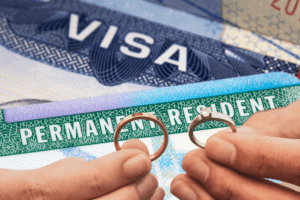 My preference always is a spouse visa because USCIS takes those cases more seriously. The couple has actually taken the legal step of getting married, which is a big deal. However, marriage isn’t always an option for a couple, or it may not be what the couple wants to do. So, in some cases, a fiancée visa is the best, or only, option for getting your fiancé to the US. Remember, however, if you start a case as a fiancé case and then get married, the fiancée case is no longer approvable and you need to start over with a spouse case. Also, remember that a fiancé does not enter the US as a lawful permanent resident (meaning doesn’t have a green card). Once the fiancée enters, you need to get married, apply for the green card, and wait for the green card to get approved.
  If your sponsor–generally your US citizen spouse–doesn’t make enough money to sponsor your green card, your spouse can use assets to supplement or replace income. Your spouse can use a savings account, retirement account, and other types of liquid accounts. Your spouse can use equity in a home or even a car. The assets will need to amount to three, or five, times the income requirement. So, for example, for a case based on marriage to a US citizen, if the sponsor needs to make $25,000 in income, but the spouse isn’t working, the spouse can show equity in a home in the amount of $75,000.
  This week, one of our clients got his green card approved. It was a long waiting period of over two years to get his green card approved. However, when his application was finally reviewed, he was approved without conducting an interview. Our firm made sure that his application was strong on paper which resulted in approval of his green card. Getting an approval of a green card without an interview is one of the best results we can achieve as an immigration firm. Congratulations to our client!
 There are two ways to get a “green card”. First, you can get one in the US through “adjustment of status”. Second, you get it through an embassy as an immigrant visa. To get an immigrant visa, you must have an approved Form I-130 based on a family-based or employment-based relationship that entitles you to a green card. After USCIS approves the I-130, your case is sent to the National Visa Center where you provide financial information and biographic information. Finally, your case gets sent to an embassy where you are interviewed on your “green card” application (or immigrant visa). Once the embassy approves the immigrant visa, you can enter the US, and that’s when the US government will mail you your green card.
 Bona fides are pieces of paper that show that your relationship is real. Real means that you married each other because you wanted a life together, not because one of you paid the other to get married to get a green card. We have a long list of examples of “bona fides” that we give our clients. Sometimes it’s really easy for client to pull together lots of documents because they have years’ worth of joint bank statements, joint leases, joint health insurance, and much more. Sometimes, that’s not the case, and so we work with our clients to figure out what documents relevant to their lives tell their story on paper. In almost all cases, we help you prepare about 5 letters of support from family and friends who can attest that you got married to live a life with your loved one.
 Going to a USCIS interview might be nerve-racking for some people. We will help you! Preparing clients for their marriage-based green card interviews or any USCIS interview ends up being a lot of fun. (Really!) You get to stroll down memory lane with your partner, remembering your story, brushing up on details of your history, and getting ready to present your story in words and on paper. To get you ready, we usually meet with our client once or twice for about 60 minutes. We make sure you feel as calm, confident, and excited as possible as you head into your USCIS interview.