

Which visas cause problems for marriage-based green card applications?
 Certain types of visas do not allow you to apply for a green card from the United States or do not allow you to apply for a green card in the United States without a waiver.
If you have entered the US on the following visas, you cannot apply for a green card from the United States unless you are eligible for a “246i” waiver:
- C/D crew visa
- K fiancé visa
- S visa
- Transit entry (no visa)
If you entered the US on an “ESTA” or tourist visa waiver program, you cannot apply for a green card from the US unless you are a qualified “immediate relative” (such as a spouse of a US citizen) or you are eligible for a “245i” waiver
If you entered the US (this entry or any entry) on J-visa with the two-year home residency and you have NOT resided in your home country for two years since you last left the US, you are not eligible to get a green card from in the US or from an embassy unless you are eligible for a waiver. Depending in the basis of your waiver, you may be able to file for the waiver and the green card at the same time, which saves over waiting for the approval of the waiver to submit your green card application.
If you need to talk to an experienced immigration attorney. We’ve helped hundreds of people traverse the complicated immigration and citizenship process. We would love to help you as well. Call (617-766-0214) or email hello@cambridgeimmigrationlaw.com to get in touch.
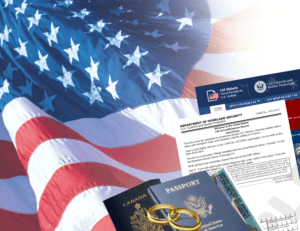 Canadians are entitled to various benefits when they enter the US. First, the visa requirements are much more lax for Canadians. Most Caan tourists do not even need a visa in their passport to enter. Many Canadians entering the US on certain visas such as the H1B or L can process their visas at the border and may in some situations be able to enter with just an I-797 Notice of Action Approval Notice. Also, Canadians are entitled to TN visas, which are available to both Canadians and Mexicans. Canadians can apply for TN visas right at the border or airport, but Mexicans must apply at an embassy, which makes the process much slower and more expensive.
  US immigration law separates visas into three categories: nonimmigrant intent visa; immigrant-intent visa; and dual-intent visas. Nonimmigrant intent means that you intend to enter the US for a specific time for a specific approved purpose and then you will return to your home country. Immigrant intent means that you plan to enter the US to live in the US permanently. Dual-intent means that you will enter the US on a visa set for a specific time and for a specific purpose, but if you decide to try to remain permanently with a green card, it’s fine.
  USCIS will only recognize your first marriage as a valid marriage for immigration purposes. With that, you do not need to disclose marriages that take place after a first marriage is still legally valid. However, talk to an experienced immigration attorney if you have engaged in a marriage ceremony while you are legally married because you may be committing a crime in certain US states and in countries outside of the US.
  What is your Marital Status? Are you engaged or married?
  You can apply to renew your two-year conditional green card by filing Form I-751, Petition to Remove Conditions on Residence, in the 90 days prior to the expiration date on your green card. For example, if your green card expires on 12/31/23, you can file anytime between October 2, 2023 and December 31, 2023. However, wait until about October 4 to file—so that it’s not early, but don’t wait until December 31, 2023 to file–make sure USCIS gets it well before December 31.
  You do not have to stay in an abusive marriage to protect your green card. US law wants you to leave your US citizen spouse’s abuse, and the US will allow you to keep your green card if you are abused by your US citizen spouse (or LPR spouse).
  If you obtained your two-year green card through marriage and your US citizen (or LPR spouse) died, you are still able to renew your green card by filing Form I-751, Petition to Remove Conditions on Residence. If you are successful, USCIS will grant you a 10-year green card (Form I-551)! To be successful on this application, you will need to show that yours was a “real” (aka bona fide) relationship and marriage. Or, in other words, you need to prove to USCIS that you did not get married just to get a green card. Also, you need to prove that your spouse died, with a death certificate.
 If you obtained your two-year green card through marriage and your US citizen (or LPR spouse) died, you are still able to renew your green card by filing Form I-751, Petition to Remove Conditions on Residence. If you are successful, USCIS will grant you a 10-year green card (Form I-551)! To be successful on this application, you will need to show that yours was a “real” (aka bona fide) relationship and marriage. Or, in other words, you need to prove to USCIS that you did not get married just to get a green card. Also, you need to prove that your spouse died, with a death certificate.
 I
I